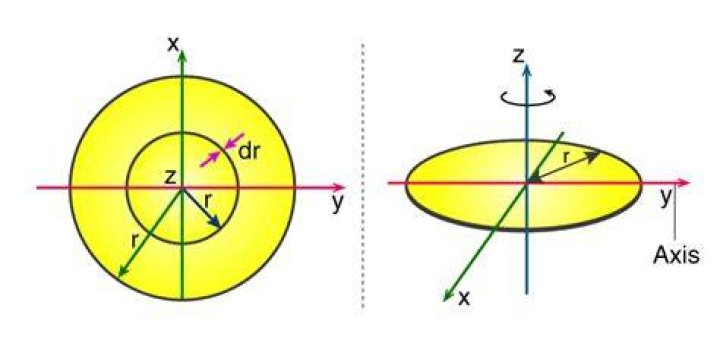
What is the moment of inertia of a dics of mass $m$ and radius $r$ about an axis through its diameter (like when spinning a coin)?
My textbook says $$I = \int r^2\, dm = \int_{-r}^r(x^2 \rho \sqrt{r^2-x^2})\, dx$$ because $dm = \rho f(x) dx$.
It may be simple but I really don't understand how we know that $dm = \rho f(x) dx$?
Thanks.
$\endgroup$1 Answer
$\begingroup$When you take a thin area element parallel to the axis of a disk, you get something like the almost-rectangle shown in the diagram below.

If the distance from the axis to the "rectangle" is $x,$ the height of the rectangle is $2 \sqrt{r^2 - x^2}.$ The width is $\mathrm dx$, so the area is $2 \sqrt{r^2 - x^2}\, \mathrm dx.$ If $\rho$ is the mass per unit area, then the mass of the rectangle is $2\rho \sqrt{r^2 - x^2}\, \mathrm dx.$ The moment of inertia of the rectangle around the parallel axis is therefore $2\rho x^2 \sqrt{r^2 - x^2}\, \mathrm dx.$
For some reason, the author of the book seems to have forgotten the factor of $2$ in the height of the rectangle, unless this is $I$ for just the top half of the disk.
$\endgroup$3