 $\begingroup$
In Spivak's Calculus 3rd Edition, there is an exercise to prove the following:
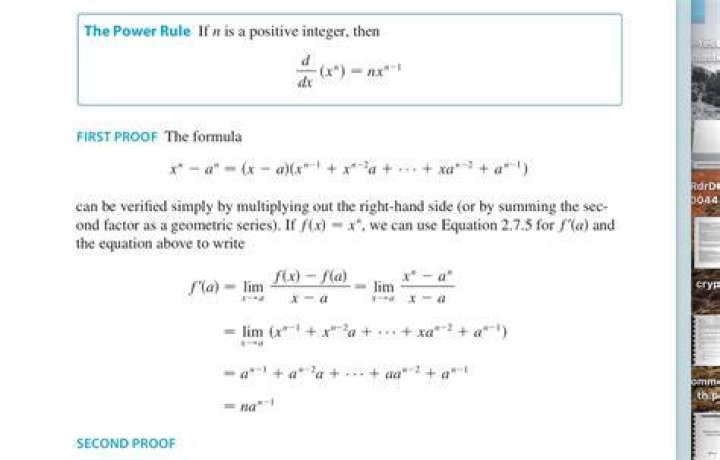
$$x^n - y^n = (x-y)(x^{n-1} + x^{n-2} y + ... + x y^{n-2} + y^{n-1})$$
I can't seem to get the answer. Either I've gone wrong somewhere, I'm overlooking something, or both. Here's my (non) proof:
$$\begin{align*} x^n - y^n &= (x - y)(x^{n-1} + x^{n-2}y +\cdots+ xy^{n-2} + y^{n-1}) \\ &= x \cdot x^{n-1} + x \cdot x^{n-2} \cdot y + \cdots + x \cdot x \cdot y^{n-2} + x \cdot y^{n-1}\\ &\qquad + (-y) \cdot x^{n-1} + (-y) \cdot x^{n-2} \cdot y + \cdots + (-y) \cdot x \cdot y^{n-2} + (-y) \cdot y^{n-1}\\ &= x^n + x^{n-1} y + \cdots + x^2 y^{n-2} + x y^{n-1} - x^{n-1}y - y^2 x^{n-2} - \cdots- x y^{n-1} - y^n \\ &= x^n + x^2 y^{n-2} - x^{n-2} y^2 - y^n \\ &\neq x^n - y^n \end{align*}$$
Is there something I can do with $x^n + x^2 y^{n-2} - x^{n-2} y^2 - y^n$ that I'm not seeing, or did I make a mistake early on?
EDIT:
I should have pointed out that this exercise is meant to be done using nine of the twelve basic properties of numbers that Spivak outlines in his book:
- Associate law for addition
- Existence of an additive identity
- Existence of additive inverses
- Commutative law for additions
- Associative law for multiplication
- Existence of a multiplicative identity
- Existence of multiplicative inverses
- Commutative law for multiplication
- Distibutive law
8 Answers
$\begingroup$You have everything right except the last line.
Maybe it is easier to do in this order:
$$(x−y)\left(x^{n−1}+x^{n−2}y+\cdots+xy^{n−2}+y^{n−1}\right)=\\ =x\cdot x^{n-1}-y\cdot x^{n-1} +x\cdot x^{n−2}y- y\cdot x^{n−2}y+x\cdot x^{n−3}y^2-\cdots\\ \cdots -y\cdot x^2y^{n-3} +x\cdot xy^{n-2}-y \cdot y^{n-1}$$
The second term $y\cdot x^{n-1}$ is the same as the third term $x\cdot x^{n−2}y$ except the sign, similarly the 4th and the 5th terms are canceled... So the only terms left are: $x\cdot x^{n-1}$ and $y\cdot y^{n-1}$.
$\endgroup$4$\begingroup$Here is the inductive step, presented more conceptually
$$\rm\frac{x^{n+1}-y^{n+1}}{x-y}\: =\ x^n\: +\ y\ \frac{x^n-y^n}{x-y}$$
So, intuitively, proceeding inductively yields
$$\rm\:x^n + y\: (x^{n-1} + y\: (x^{n-2} +\:\cdots\:))\ =\ x^n + y\: x^{n-1} + y^2\: x^{n-2} + \:\cdots $$
Use this intuition to compose a formal proof by induction.
$\endgroup$1$\begingroup$I think it would be easier for you to recall
$$\left(1+x+x^2+\cdots+x^{n-1}\right)(x-1) = x^n-1$$
and put $x=\dfrac{b}{a}$
$$\eqalign{ & \left( {1 + \frac{b}{a} + \frac{{{b^2}}}{{{a^2}}} + \cdots + \frac{{{b^{n - 1}}}}{{{a^{n - 1}}}}} \right)\left( {\frac{b}{a} - 1} \right) = \frac{{{b^n}}}{{{a^n}}} - 1 \cr & \left( {1 + \frac{b}{a} + \frac{{{b^2}}}{{{a^2}}} + \cdots + \frac{{{b^{n - 1}}}}{{{a^{n - 1}}}}} \right)\left( {\frac{{b - a}}{a}} \right) = \frac{{{b^n} - {a^n}}}{{{a^n}}} \cr & {a^{n - 1}}\left( {1 + \frac{b}{a} + \frac{{{b^2}}}{{{a^2}}} + \cdots + \frac{{{b^{n - 1}}}}{{{a^{n - 1}}}}} \right)\left( {b - a} \right) = {b^n} - {a^n} \cr & \left( {{a^{n - 1}} + b{a^{n - 2}} + {b^2}{a^{n - 3}} + \cdots + {b^{n - 1}}} \right)\left( {b - a} \right) = {b^n} - {a^n} \cr} $$
A little bit "tidier", so that we know what happens in between the dots...
$$\eqalign{ & {x^n} - 1 = \left( {x - 1} \right)\sum\limits_{k = 0}^{n - 1} {{x^k}} \cr & \frac{{{b^n}}}{{{a^n}}} - 1 = \left( {\frac{b}{a} - 1} \right)\sum\limits_{k = 0}^{n - 1} {\frac{{{b^k}}}{{{a^k}}}} \cr & \frac{{{b^n} - {a^n}}}{{{a^n}}} = \left( {\frac{{b - a}}{a}} \right)\sum\limits_{k = 0}^{n - 1} {\frac{{{b^k}}}{{{a^k}}}} \cr & {b^n} - {a^n} = \left( {b - a} \right)\sum\limits_{k = 0}^{n - 1} {{b^k}{a^{n - k - 1}}} \cr} $$
$\endgroup$$\begingroup$Your method is sound, you just made a sort of arithmetic mistake. When cancelling or otherwise combining two sequences, try explicitly lining things up to make sure you do it right:
$$ \begin{align} x^n &+& x^{n-1} y &+& x^{n-2} y^2 &+& \cdots + x y^{n-1} & \\ &-& x^{n-1} y &-& x^{n-2} y^2 &+& \cdots - x y^{n-1} &+& y^n \end{align} $$
I've found that, when shorthand starts becoming awkward and/or error prone, that it really is helpful to switch to summation notation. So, you are trying to prove
$$ x^n - y^n = (x-y) \sum_{k=0}^{n-1} x^k y^{n-1-k} $$
and the first stem of your work would be
$$ \cdots = \left( \sum_{k=0}^{n-1} x^{k+1} y^{n-1-k} \right) - \left( \sum_{k=0}^{n-1} x^{k} y^{n-k} \right)$$
and now, we can change the index to line things up: I'm substituting k = j-1:
$$ \cdots = \left( \sum_{(j-1)=0}^{n-1} x^{(j-1)+1} y^{n-1-(j-1)} \right) - \left( \sum_{k=0}^{n-1} x^{k} y^{n-k} \right)$$ and simplifying
$$ \cdots = \left( \sum_{j=1}^{n} x^{j} y^{n-j} \right) - \left( \sum_{k=0}^{n-1} x^{k} y^{n-k} \right)$$
and now replacing $j$ with $k$.
$$ \cdots = \left( \sum_{k=1}^{n} x^{k} y^{n-k} \right) - \left( \sum_{k=0}^{n-1} x^{k} y^{n-k} \right)$$
(can you take it from here?)
$\endgroup$$\begingroup$The $x^2 y^{n-2}$ term from $x \cdot x y^{n-2}$ is cancelled by the term from $(-y) \cdot x^2 y^{n-3}$. Similarly, the $(-y) \cdot x^{n-2} y$ is cancelled by the $x \cdot x^{n-3} y^2$.
$\endgroup$$\begingroup$Since powers of x and y is always greater than or equal to zero, You can prove it by mathematical induction.
$\endgroup$$\begingroup$Sorry but I don't speak English well but I will try to write as correctly as possible.
Your demonstration is correct, but your idea of cancellation is incorrect.
$x^n−y^n=(x−y)(x^\left(n−1\right)+x^\left(n−2\right)y+⋯+xy^\left(n−2\right)+y^\left(n−1\right))$
When we multiply first for 'x' to our terms of the second parenthesis let's notice that all terms that contains 'x' go up one grade, this by exponent laws. When we multiplies for 'y' to our terms of the second parenthesis let's notice that all terms that contains y go up one grade but the terms that contains x remain the same. Therefore at the moment to cancel our terms, "ellipsis" of the formula cancel the terms left over in your demostration.
This is your result $x^n+x^2y^\left(n−2\right)−x^\left(n−2\right)y^2−y^n$ the extra term $+x^2y^\left(n−2\right)$is "cancel" by the "ellipsis" because the term that is not visible but is in the "ellipsis" in the second parenthesis is $(x^\left(n−1\right)+x^\left(n−2\right)y+⋯ (x^2y^\left(n-3\right)) ⋯+xy^\left(n−2\right)+y^\left(n−1\right)$ because on the left one degree goes up the 'x' and one degree goes down the y and cancel your term. Analogously the other extra term $-x^\left(n−2\right)y^2$ is cancel by the other "ellipsis" that came out of the first multiplication by x.
$x^n−y^n=(x−y)(x^\left(n−1\right)+x^\left(n−2\right)y+⋯+xy^\left(n−2\right)+y^\left(n−1\right))$
Dem.
By distributive law we have
$x(x^\left(n-1\right)+x^\left(n-2\right)y+...+xy^\left(n-2\right)+y^\left(n-1\right))$
$-y(x^\left(n-1\right)+x^\left(n-2\right)y+...+xy^\left(n-2\right)+y^\left(n-1\right))$ from where
$\quad x^n+x^\left(n-1\right)y+.........+x^2y^\left(n-2\right)+xy^\left(n-1\right)$
$\qquad -(x^\left(n-1\right)y+x^\left(n-2\right)y^2+.........+xy^\left(n-1\right)+y^n)$ therefore
$x^n-y^n$
$\endgroup$$\begingroup$Since $x^{n-1} + x^{n-2} y + \dots + x y^{n-2} + y^{n-1}$ is a geometric series with $n$ terms and a common factor of $y/x$, it equals $$ \frac{x^{n-1}\left(1-\left(\frac{y}{x}\right)^n\right)}{1-\frac{y}{x}}=\frac{x^{n}\left(1-\left(\frac{y}{x}\right)^n\right)}{x-y}=\frac{x^n-y^n}{x-y} \, ; $$ multiplying through by $(x-y)$ gives the desired result.
$\endgroup$