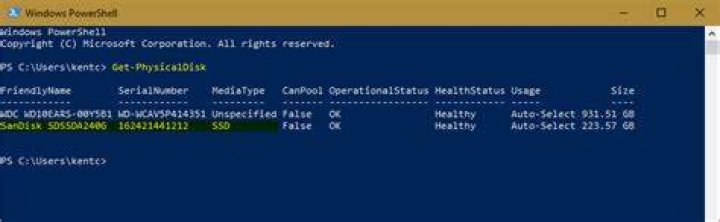

I ran Get-PhysicalDisk inside a virtual machine which has 4 hard disks. The result was:
FriendlyName SerialNumber CanPool OperationalStatus HealthStatus Usage Size ------------ ------------ ------- ----------------- ------------ ----- ---- VMware, VMware Virtual S False OK Healthy Auto-Select 60 GB VMware, VMware Virtual S False OK Healthy Auto-Select 100 GB VMware, VMware Virtual S False OK Healthy Auto-Select 200 GB VMware, VMware Virtual S False OK Healthy Auto-Select 400 GB There were no SerialNumber's or any other unique ID that I could see in the result above.
Now, I need to run Set-PhysicalDisk. All examples on the web use the unique FriendlyName or something like PhysicalDisk1. First, there are 4 disks with the same FriendlyName's, so I think I cannot use it. Secondly, I thought PhysicalDisk{number} was a special name to point a disk by the index, but it did not seem to work.
What should I pass to Set-PhysicalDisk, if I want to designate, say, the second disk above (size = 100GB)?
PS C:\Users\Administrator> Set-PhysicalDisk -FriendlyName "VMware, VMware Virtual S" -Usage Retired Set-PhysicalDisk : Not Supported At line:1 char:1 + Set-PhysicalDisk -FriendlyName "VMware, VMware Virtual S" -Usage Reti ... + ~~~~~~~~~~~~~~~~~~~~~~~~~~~~~~~~~~~~~~~~~~~~~~~~~~~~~~~~~~~~~~~~~~~~~ + CategoryInfo : InvalidOperation: (StorageWMI:ROOT/Microsoft/..._StorageCmdlets) [Set-PhysicalDisk], CimException + FullyQualifiedErrorId : StorageWMI 1,Set-PhysicalDisk PS C:\Users\Administrator> Set-PhysicalDisk PhysicalDisk1 -Usage Retired Set-PhysicalDisk : The requested object could not be found. At line:1 char:1 + Set-PhysicalDisk PhysicalDisk1 -Usage Retired + ~~~~~~~~~~~~~~~~~~~~~~~~~~~~~~~~~~~~~~~~~~~~~ + CategoryInfo : ObjectNotFound: (PS_StorageCmdlets:ROOT/Microsoft/..._StorageCmdlets) [Set-PhysicalDisk], CimException 3 Answers
You can Set-PhysicalDisk by using the UniqueID.
To retrieve the UniqueID,
Get-PhysicalDisk | Select-Object SerialNumber,UniqueID To make updates based on the UniqueID,
Set-PhysicalDisk -UniqueId "{<insert_UniqueID>}" You can assign that disk "object" to a variable. With that variable you can perform the operations on the variable itself - all without even needing a FriendlyName or SerialNumber
Details
In my case i had no FriendlyName, nor any SerialNumber:
FriendlyName CanPool OperationalStatus HealthStatus Usage Size ------------ ------- ----------------- ------------ ----- ---- PhysicalDisk1 False OK Healthy Auto-Select 1.82 TB PhysicalDisk3 False OK Healthy Auto-Select 1.82 TB PhysicalDisk4 False OK Healthy Auto-Select 1.82 TB PhysicalDisk0 False OK Healthy Auto-Select 111.79 GB PhysicalDisk8 False OK Healthy Auto-Select 1.82 TB PhysicalDisk2 False OK Healthy Auto-Select 465.76 GB False Lost Communication Warning Retired 930.75 GB PhysicalDisk6 False OK Healthy Auto-Select 930.75 GB PhysicalDisk9 False OK Healthy Auto-Select 930.75 GB PhysicalDisk7 False OK Healthy Auto-Select 1.82 TB PhysicalDisk5 False OK Healthy Auto-Select 1.82 TB The easiest thing i could key on was that the OperationalStatus said Lost Communication:
#Single out the disk that has lost communication Get-PhysicalDisk | Where-Object { $_.OperationalStatus -eq 'Lost Communication' } From there i can assign that disk to a variable:
#Assign the missing disk to a variable $missingDisk = Get-PhysicalDisk | Where-Object { $_.OperationalStatus -eq 'Lost Communication' } Now that i have a variable object, i can mark that disk as retired:
#tell the storage pool that the disk has been retired: $missingDisk | Set-PhysicalDisk -Usage Retired And then to top it off, repair all volumes on the storage space that were affected:
# To Repair all Warning Volumes Get-VirtualDisk | Where-Object –FilterScript {$_.HealthStatus –Eq 'Warning'} | Repair-VirtualDisk You can confirm that a virtual disk is being repaired by seeing that its OperationStatus is InService:
#Disks will show as `InService` to let us know that they're currently being repaired Get-VirtualDisks FriendlyName ResiliencySettingName OperationalStatus HealthStatus IsManualAttach Size ------------ --------------------- ----------------- ------------ -------------- ---- Three-way mirror Mirror InService Warning False 10 TB PooledParityDisk Parity InService Warning False 15 TB And finally you can monitor the progress of the repair:
#Monitor the percentage of the repair Get-StorageJob Name ElapsedTime JobState PercentComplete IsBackgroundTask ---- ----------- -------- --------------- ---------------- Regeneration 00:00:00 Running 40 True Regeneration 00:00:00 New 0 True Thanks to Matthew Hodgkins. (archive)
p.s. the person thinking PowerShell is a good idea should be shot
When I run into this issue, I turn to Select-Object ()
This isn't terribly elegant, but if you can list your objects and know you want only specific ones, you can array index them with Select-Object.
i.e. if you want to operate on the third hard drive:
Get-PhysicalDisk | Select-Object -Index 2 | Set-PhysicalDisk...