 $\begingroup$
Is the following statement always true?
Let $A \in GL_n( \mathbb Z)$. If $\det(A^2)= \det(A)$, then $A^2 \in \{A, A^{-1}, -A, -A^{-1}\}$ .
Note: $GL_n(\mathbb Z)$ is defined as the set of all invertible $n \times n$ matrices over $\mathbb Z$.
I think that the statement is true because $det(A^2)=det(A)$ is true if $A = E_n$ and so $\det(A^2)=\det(A) \equiv \det(A) \cdot \det(A)=\det(A) \equiv 1 \cdot 1 = 1$ and thus $A^2 \in \{A, A^{-1}, -A, -A^{-1}\} $
Question: Is that guess correct?
The question is related to that post.
$\endgroup$32 Answers
$\begingroup$The condition $\det(A)=\det(A^2)$ is equivalent to $\det(A)=1$, but that doesn't mean that $A^2$ should be equal to $\pm A$ or $\pm A^{-1}$.
For example, take $$A=\begin{pmatrix}1&1\\0&1\end{pmatrix}.$$ Then $$A^2=\begin{pmatrix}1&2\\0&1\end{pmatrix}\quad \text{and}\quad A^{-1}=\begin{pmatrix}1&-1\\0&1\end{pmatrix}$$ so that $\det (A)=1=\det(A^2)$, but $A^2\notin \left\{A,A^{-1},-A,-A^{-1}\right\}$.
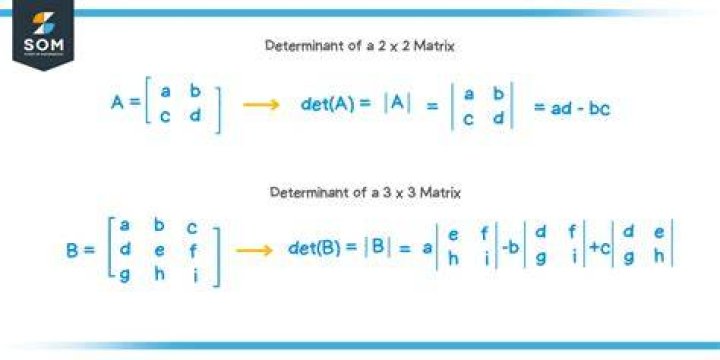
$\endgroup$$\begingroup$$|AB| = |A||B|$ for square matrices $A$ and $B$ of the same order. So $|A^2| = |A|^2$. Hence $|A^2| = |A|$ is equivalent to $|A| = 0$ or $|A| = 1$. This we can conclude.
$\endgroup$