 $\begingroup$
I am stuck at one task, it's to proof the following equation using addition theorems. From a draft I understood that the equation is correct or true. But that's it. What's a good way to explain it mathematically?
$$\sin (x)+ \sin(y) = 2 \sin \left(\frac{x+y}{2}\right) \cos\left(\frac{x-y}{2}\right)$$
As usual, any help is upvoted immediately.
$\endgroup$14 Answers
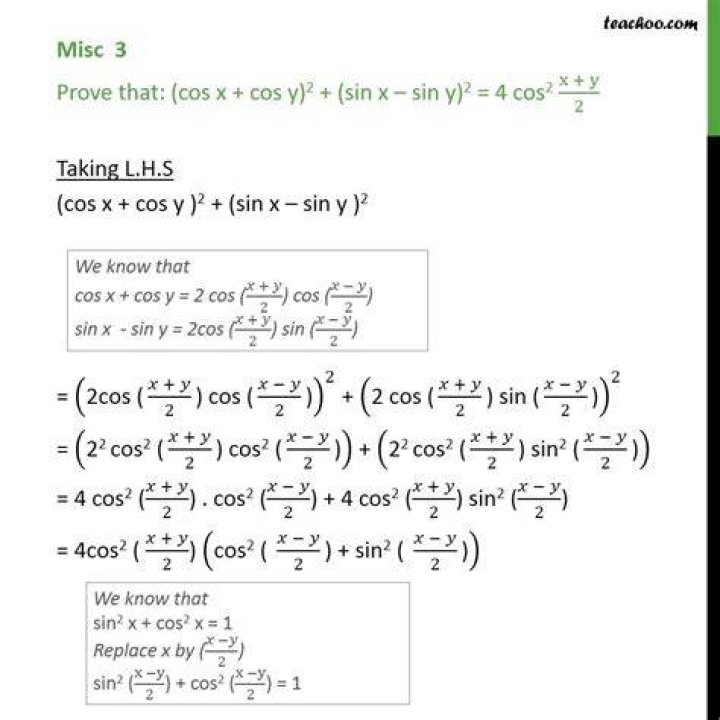
$\begingroup$Everyone should know these factorisation formulae: \begin{alignat*}{2} &2\cos a \cos b&&=\cos(a-b)+\cos(a+b)\\ &2\sin a\sin b&&=\cos(a-b)-\cos(a+b)\\ &2\sin a\cos b&&=\sin(a-b)+\sin(a+b) \end{alignat*}
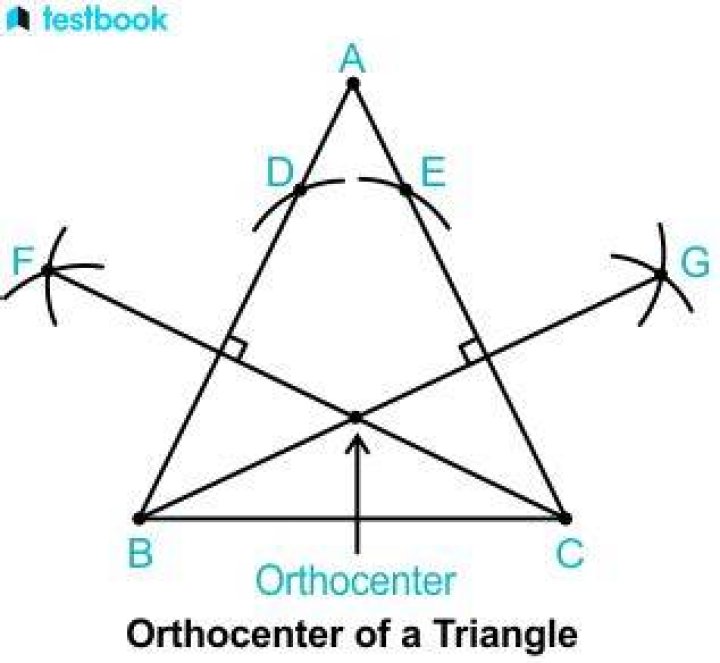
$\endgroup$$\begingroup$here is a geometric way to see this. i will take the point $T$ on the unit circle centered at $O=(0,0)$ with arc length $t$ measured from $A = (1,0)$ to have the coordinates $x = \cos t, y = \sin t.$ pick another point $S = (\cos s, \sin s).$ let the midpoint of $ST$ be $U.$ then $U= \left(\frac{\cos t + \cos s}2, \frac{\sin t + \sin s}2\right).$
now, a little bit of geometry. from the right angle triangle $OTU,$ we have $OU = \cos \left(\frac{s-t}2\right)$ we can scale the point $U$ by dividing by $OU$ so that the scaled point will be on the unit circle. that makes $$\sin\left(\frac{s+t}2\right) = \frac{\frac{\sin t + \sin s}2}{ \cos \left(\frac{s-t}2\right)}$$ multiplying out should give you the desired result.
$\endgroup$$\begingroup$Apply to the two factors on the right the formula
$$\sin(\alpha+\beta)=\sin\alpha\cos\beta+\cos\alpha\sin\beta$$
and its twin for the cosine.
My favourite explanation actually involves physics: on the left hand side we have the sound of two strings on musical instruments where one of the two is very slightly off-key, i.e., the tones have nearly equal but different frequencies. Then the right hand side tells you the result is as if a single note is played with the average frequency ($\frac{x+y}2$) but modulated with a low frequency ($\frac{x-y}2$) so that you hear a wow-wow sound known as "beats".
$\endgroup$1$\begingroup$The relevant addition formulae tell you that: $$ \sin(A + B) = \sin(A)\cos(B) + \cos(A)\sin(B)\\ \cos(A + B) = \cos(A)\cos(B) - \sin(A)\sin(B) $$
Applying these to $2\sin\left(\frac{x+y}{2}\right)\cos\left(\frac{x-y}{2}\right)$ yields: $$ \begin{align*} 2\sin\left(\frac{x+y}{2}\right)\cos\left(\frac{x-y}{2}\right) & = 2\left[\sin(x/2)\cos(y/2) + \cos(x/2)\sin(y/2)\right]\left[\cos(x/2)\cos(y/2) + \sin(x/2)\sin(y/2)\right]\\ & = 2\sin(x/2)\cos(x/2)\cos^2(y/2) + 2\sin^2(x/2)\sin(y/2)\cos(y/2)\\ & \hspace{20pt}+ 2\cos^2(x/2)\sin(y/2)\cos(y/2) + 2\sin(x/2)\cos(x/2)\sin^2(y/2)\\ & = 2\sin(x/2)\cos(x/2)\left[\sin^2(y/2) + \cos^2(y/2)\right]\\ & \hspace{20pt}+ 2\sin(y/2)\cos(y/2)\left[\sin^2(x/2) + \cos^2(x/2)\right]\\ & = 2\sin(x/2)\cos(x/2) + 2\sin(y/2)\cos(y/2) \end{align*} $$ From here, can you make the final step?
$\endgroup$