 $\begingroup$
How is it that $$\tan(A +B) = \frac{\tan A + \tan B}{1-\tan A\tan B}$$ for any value of $A$, $B$?
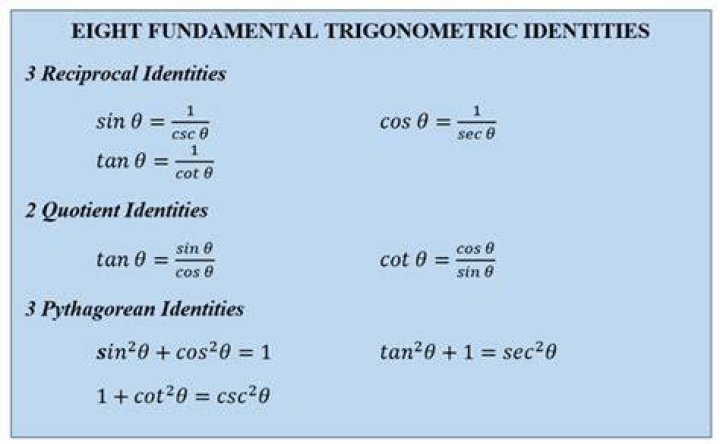
I have doubts about this since we arrive at this by dividing the numerator and denominator of $$\frac{\sin(A+B)}{\cos(A+B)}$$ by $\cos A \cdot \cos B$, which can only be done when $\cos A\cdot\cos B$ is not equal to zero.
$\endgroup$52 Answers
$\begingroup$You can think it like this way: If either cos(A) or cos(B) is zero, then we may take its limit of RHS and the equality makes sense.
$\endgroup$$\begingroup$Note that $$\tan(A +B) = \frac{\tan A + \tan B}{1-\tan A\tan B}$$ holds only if both $(i)\space A\ne \frac{\pi}{2}+k\pi$ and $(ii)\space B\ne \frac{\pi}{2}+l\pi$ for all $k,l\in\mathbb{Z}$ are satisfied. Otherwise, at least one of the values $\tan A$ or $\tan B$ does not exist since $\tan x=\frac{\sin x}{\cos x}$ whilst the zeros of cosine are of the aforementioned form.
The inconvenient case, though, one could simplify directly. Suppose $(i)$ holds, then $$ \tan(A+B)= \tan\left(\frac{\pi}{2}+k\pi+B\right)\stackrel{\text{periodicity}}{=}\tan\left(\frac{\pi}{2}+B \right) \stackrel{\text{trig. identity}}{=}-\cot(B).$$
Assured of ability to handle the tangent of sum when $(i)$ or $(ii)$ is true, one can assume that both $\cos A$ and $\cos B$ are not $0$ and divide by it in order to obtain the discussed expression.
$\endgroup$