 $\begingroup$
Given that $\log_ba=\log_ab$, and that $a,b \ne 1$ and $a \ne b$, find $b$ in terms of $a$.
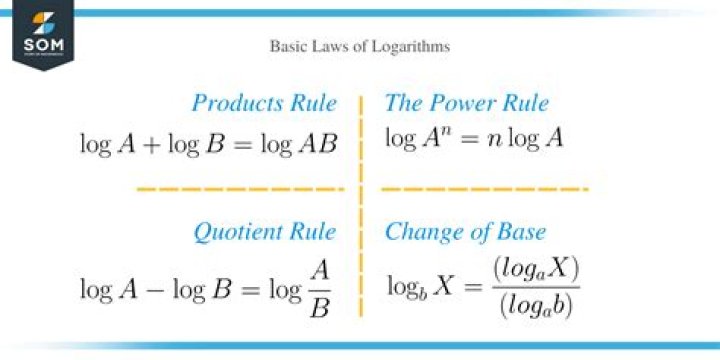
I tried to solve this problem using changing the base of the first part of the equation: $$ \frac{\log_bb}{\log_ba} = \frac{1}{\log_ba} $$ Then multiply both sides by $\log_ba$ and got the following: $$ 1=(\log_ab)^2 $$ Therefore $1=\log_ab$. But this means that $a=b$.
How can I find $b$ in terms of $a$ where $a$ is not equal to $b$?
$\endgroup$13 Answers
$\begingroup$$$\log_a b = \dfrac{\ln b}{\ln a}$$
So, we can rewrite the original problem as:
$$\dfrac{\ln a}{\ln b} = \dfrac{\ln b}{\ln a}$$
Then, cross multiply to get:
$$\left(\ln a \right)^2 = \left(\ln b \right)^2$$
Taking square roots, we have:
$$\ln b = \pm \ln a$$
Raise both sides as the power of $e$ and get:
$$b = a^{\pm 1}$$
But, we can eliminate one of those answers (because we know $b \neq a$).
$\endgroup$$\begingroup$You're doing very well, until finding that $\log_ab=1$, forgetting that it could also be $$ \log_ab=-1 $$ which implies $b=a^{-1}$.
$\endgroup$$\begingroup$Let $a,b >0$.
$a^x=b$; and $b^x= a$.
$(a/b)^x =(b/a) \rightarrow x=-1$.
Then $a^{-1}= b$.
$\endgroup$