I need to be able to calculate and find the true center of rotation (x,y) of an object after it has been rotated by a known angle.
Previously I would simply find the center of the object, rotate 180 degrees, find the new center of the object, and calculate the midpoint of the line that connects the 2 centers to find the true center of rotation. Now, I don't have the luxury of being able to rotate 180 degrees, instead it will be only 10-15 degrees, but it will be known.
I've searched for a while and haven't found the appropriate equation to solve my particular problem.
Limitation: Only know center of object, cannot use multiple points found on object.
Knowns: Center of object before and after rotation, and angle of rotation
Unknown: True center of rotation
 Hopefully the image explains what I'm shooting for
Thanks
$\endgroup$23 Answers
$\begingroup$Let point $C$ be the center of rotation.
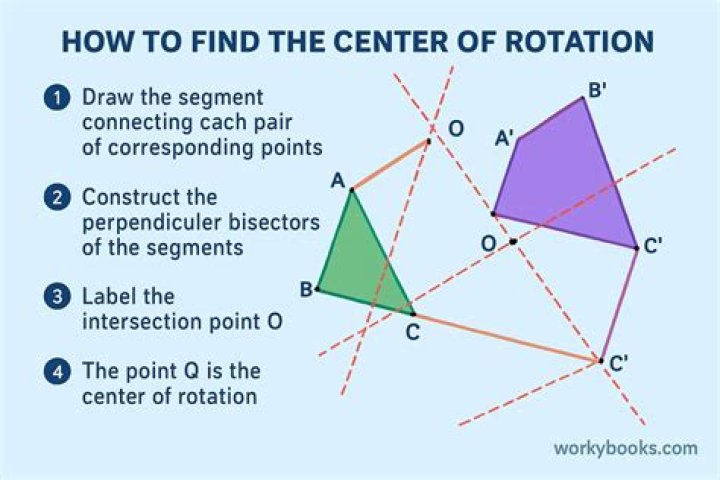
It should belong to the perpendicular bisector of the segment $[P, P']$.
So if we imagine it as a triangle, $CPP'$ should be a equilateral triangle where the angle $C = 15^0$ (Or whatever your rotation angle below 180). Let's assemble it in a drawing: 
Your task can be minimized to computing $M$!:
Knowns:
- $d = \frac{PP'}{2}$
- $\theta = 15^o$ (rotation angle).
Solution:
Notice that: $\frac{d}{M} = tan(\frac{\theta}{2})$
So $M = \frac{d}{tan(\frac{\theta}{2})}$
Now you have all the necessary information to find your center of rotation $C$, I will left to you to transform everything to $(x,y)$ coordinates as an exercise ;)
$\endgroup$$\begingroup$The center of the rotation is on the mediatrix of [P,P']. Now, using the half of the angle, and the half of [P,P'], you can determine the position of the center on the mediatrix thx to the formula
tg(alpha/2) = PP'/2 / (position of center). Apologies for brief response and a rough sketch.
The coordinates of P,P' and $\alpha $ are given
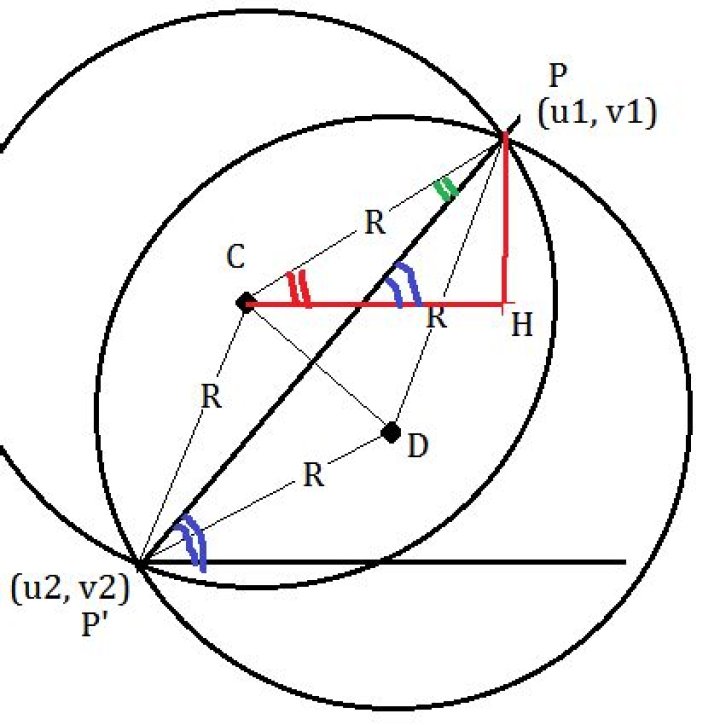
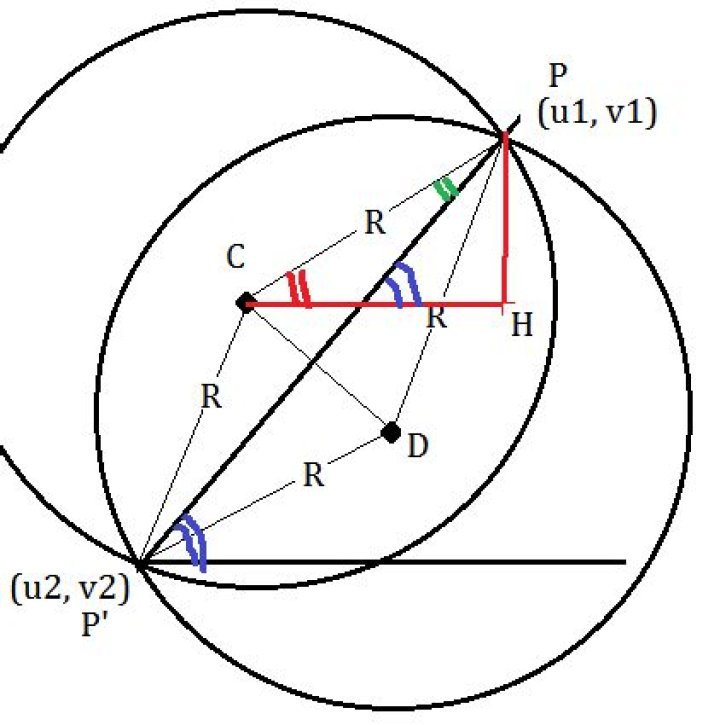
As mentioned in the other posts, we can find the radius R and inclination between radius/chord.
$$ d= PP' ;\, R= \frac{d/2}{\sin \alpha/2} ; $$
Inclination to horizontal is known (blue)
Also angle CPP' is known (green), $ =\cos^{-1} \frac{PP'/2}{R} $ complement of $ \alpha/2$
The difference angle as marked (red) say $ =\gamma$.
Subtract $ (R \cos \gamma, R \sin \gamma) $ from corresponding coordinates of P.
There are two solutions on each side of PP', D can also be found similarly.