 $\begingroup$
Problem:
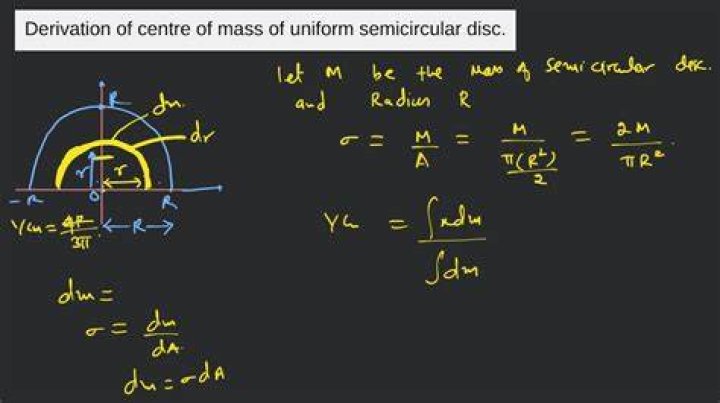
Derive the Center of Mass of a semi-circular disk of mass $M$ and radius $R$.
My attempt:
$$Y_{CM}=\int ydm$$
Now, $$dm=\sigma dA$$ where $\sigma$ is mass per unit area.
Converting into Cylindrical Coordinates,$$dA=rdrd\theta$$. Also, $$y=r\sin\theta$$
Hence the integral can be rewrittenn as
$$\int_0^R\int_0^{\pi}r^2\sin\theta d\theta dr$$
However this Integral gives me the wrong value of the Y coordinate of the Center of Mass.
I would be truly grateful for any help with this problem.
$\endgroup$3 Answers
$\begingroup$The center of mass of a uniform half-disk obviously lies on the perpendicular bisector of the base diameter, at distance $d$ from the centre of the disk. By the Pappus centroid theorem,
$$ 2\pi d \cdot \frac{\pi}{2}R^2 = \frac{4\pi}{3}R^3, $$ hence $d=\color{red}{\large\frac{4R}{3\pi}}$.
$\endgroup$5$\begingroup$Notice, your formula $Y_{CM} = \displaystyle{\int y\ dm}$ is not correct.
the center of mass is given as $$Y_{CM}=\frac{\displaystyle{\int y\ dm}}{\displaystyle{\int dm}}$$ Now, substituting the values $y=r\sin \theta$ & $dm=\sigma rdrd\theta$, we get
$$Y_{CM}=\frac{\displaystyle{\int_{0}^{R}\int_{0}^{\pi} \sigma r^2\sin\theta d\theta\ dr}}{\displaystyle{\int_{0}^{R}\int_{0}^{\pi}\sigma r d\theta\ dr}}$$
$$=\frac{\displaystyle{\int_{0}^{R}\left(\int_{0}^{\pi}\sin\theta d\theta\right)r^2\ dr}}{\displaystyle{\int_{0}^{R}\left(\int_{0}^{\pi}d\theta\right)r\ dr}}$$
$$ = \frac{\displaystyle{\int_{0}^{R}\left(2\right)r^2\ dr}}{\displaystyle{\int_{0}^{R}\left(\pi\right)r\ dr}} = \frac{\displaystyle{2\int_{0}^{R}r^2\ dr}}{\displaystyle{\pi\int_{0}^{R}r\ dr}}$$
$$ = \frac{2\left[\frac{r^3}{3}\right]_{0}^{R}}{\pi\left[\frac{r^2}{2}\right]_{0}^{R}}$$
$$ = \frac{4R^3}{3\pi R^2} = \frac{4R}{3\pi}$$
$$\bbox[5pt, border:2.5pt solid #FF0000]{\color{blue}{Y_{CM}=\frac{4R}{3\pi}}}$$
$\endgroup$$\begingroup$The x-coordinate is at $(0,0)$ and y-coordinate will change
$$\bar{y}=\frac{\displaystyle{\int y\ dm}}{\displaystyle{\int dm}}$$ plugging in values and solve The answer is clearly
$\bar y=\frac{4r}{3\pi}$
$\endgroup$1