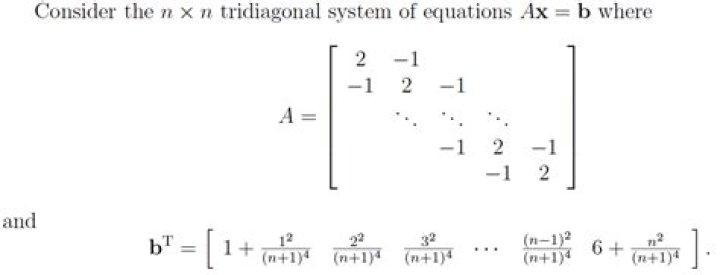
How can I create a tridiagonal matrix that I can use for Crout factorization? And, I don't have any codes on how to create one since I am new to matlab.

Ok, please help me understand what does the sentence "The program should output the $\infty$ norm of the residual of your computed solution and the number of iterations used" mean in this case? I am all confused figuring this out.
$\endgroup$4 Answers
$\begingroup$>> n = 10; >> full(gallery('tridiag',n,-1,2,-1)) ans = 2 -1 0 0 0 0 0 0 0 0 -1 2 -1 0 0 0 0 0 0 0 0 -1 2 -1 0 0 0 0 0 0 0 0 -1 2 -1 0 0 0 0 0 0 0 0 -1 2 -1 0 0 0 0 0 0 0 0 -1 2 -1 0 0 0 0 0 0 0 0 -1 2 -1 0 0 0 0 0 0 0 0 -1 2 -1 0 0 0 0 0 0 0 0 -1 2 -1 0 0 0 0 0 0 0 0 -1 2 Crout:
% Source: % MATLAB implementation of Crout reduction algorithm (p. 140 of your book) function [L,U] = crout(A,n) % returns two matrices for i = 1:n L(i,1) = A(i,1); end for j = 1:n U(1,j) = A(1,j)/L(1,1); end for j = 2:n for i = j:n sum = 0.0; for k = 1:(j-1) sum = sum + L(i,k) * U(k,j); end L(i,j) = A(i,j) - sum; end U(j,j) = 1; for i = (j+1):n sum = 0.0; for k = 1:(j-1) sum = sum + L(j,k) * U(k,i); end U(j,i) = (A(j,i) - sum)/L(j,j); end end The tridiagonal part can be created using sums of calls to diag()
n = 5 ; nOnes = ones(n, 1) ; x = diag(2 * nOnes, 0) - diag(nOnes(1:n-1), -1) - diag(nOnes(1:n-1), 1) x = 2 -1 0 0 0 -1 2 -1 0 0 0 -1 2 -1 0 0 0 -1 2 -1 0 0 0 -1 2 In your case
toeplitz([2 -1 zeros(1, N-2)], [2 -1 zeros(1, N-2)]) or even
toeplitz([2 -1 zeros(1, N-2)]) You could also use conv2 to create a tridiagonal matrix
B = conv2(eye(5),[-1 2 -1],'same'); B = 2 -1 0 0 0 -1 2 -1 0 0 0 -1 2 -1 0 0 0 -1 2 -1 0 0 0 -1 2